
It’s been a while since I’ve searched for lyrics to a song half-remembered or plot elements of TV episode from decades ago (eg “murder mystery woman cat purple dress locked out of apartment”) without accessing the name (and sometimes grainy VHS rips on YouTube) in one click.
But recently I got stumped. Visiting The Clock at LACMA a couple weeks ago, I was struck by one of the clips between 5 and 6pm.
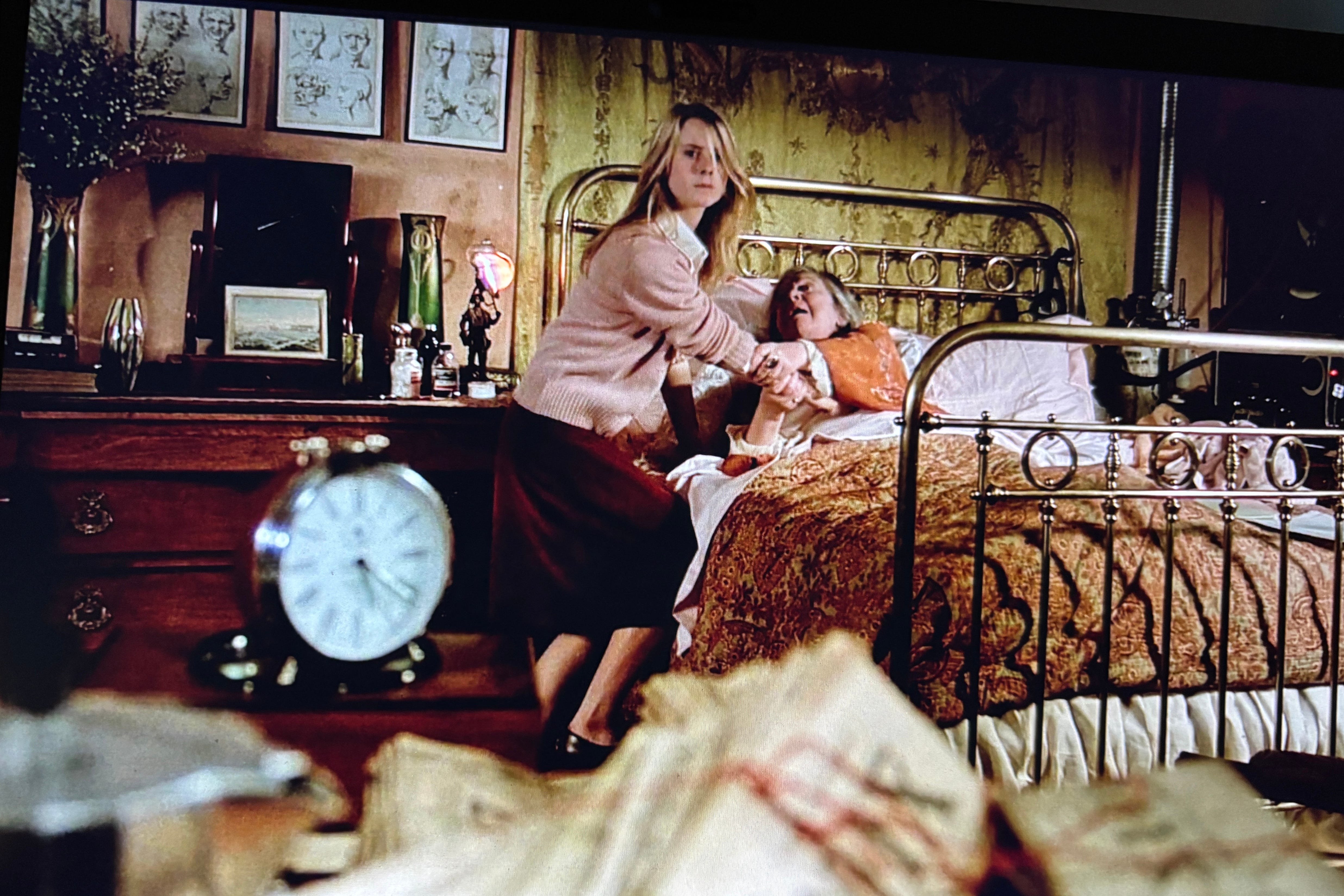
There’s a teenage girl pacing around a bedroom where an old woman is lying down. The room is full of books and antiques. The old woman is in hysterics reaching for the girl as an alarm clock goes off. The girl shakes the old woman’s arms away and turns off the alarm clock. The alarm goes off again and she shuts it off again. It brrrrings once more and she throws the alarm clock out the window. The old woman appears to be dying as yet another alarm clock goes off. Another alarm clock goes off, and another, and another. The girl finds all the clocks around the room and throws each of them out the window. I had no idea where this scene came from, despite having a pretty annoyingly comprehensive knowledge of feminist and surreal cinema. It felt like a French or German film but they were speaking English. Judging by the clothes and style, it was made sometime in the 70s or the 80s. I had it in my mind that once I left the theater, I’d find out what the movie it comes from was, and watch it immediately.
I visited The Clock several times this summer and each time there was at least one clip I wanted to identify when I got out. Watching an unlikely pair of actors waking up next to each other early in the morning, it took me no time to discover The Tall Guy (1989) staring Emma Thompson and Jeff Goldblum when I stepped out for breakfast. Another time, late afternoon, I was curious about a romantic scene in which Robert De Niro races to find Meryl Streep at Grand Central Station. (This was an easy one: Falling in Love. It’s pretty good. On Hoopla and Tubi, fwiw).
The last time I saw The Clock was in 2011, I visited it several times at Paula Cooper Gallery and later, again, when it played in Boston at the MFA. My memory is hazy, but I don’t recall walking out with a mental “to lookup” lists after those visits as I did this year.
“Movie where the girl throws alarm clocks out the window” seemed in the moment like a slam dunk search string. But the big evil search engine and its stupid evil AI agent overview sent me to the IMDB and Wikipedia pages for Isn’t it Romantic with Rebel Wilson, Agatha Christie’s Seven Dials, 1408, The Lovely Bones, and television shows Servant and The Golden Girls....“Movie where the girl throws alarm clocks out the window old woman dying in bed” directed me to The Woman in the Window, The Amityville Horror, and the TV show, “From.” I tried a few other times with more specificity yet still, nothing.
Then, I looked for lists of films appearing in The Clock. I first stumbled upon a wiki that hadn’t been updated in over a decade. There were blanks and inaccuracies, compiled as it was, in the age of blogs and before the age of Letterboxd completists. Eventually I landed on a properly thorough directory and that’s when I found out the clip comes from Louis Malle’s Black Moon, from 1975, which has been on my watch list on the Criterion Channel forever. (I did watch it immediately. Sadly, nothing in it comes close to the dreamy chaos of that alarm clock hurling scene).
If I had seen this clip in 2011, I probably would have searched to find it. Because I wasn’t just curious, I was passionate about it. The film didn’t change my life, but in the three minutes that I watched that clip I thought it had the potential to; I probably wouldn’t have bothered to try to identify The Tall Guy or Falling in Love back then. For as bad as search engines are now, the corpus of information available on the web vastly exceeds what was there in 2011. Around the time it became very easy to find out titles of songs and movies and episodes is when I started looking them up out of habit, not because I particularly cared.
I guess what I’m describing here is the difference between obsessional or passionate attention. There’s the pursuit of information as way to find joy—even the search itself can be pleasurable—and then there is compulsory completion, a kneejerk response to feeling unmoored where there are blanks in the trivia with which we are familiar.
Lately, I’ve been thinking I need to get more comfortable with the blanks. Why does it matter whether I know the name of a movie I have no interest in seeing or seeing again? To put it more directly: what do I get from knowing about things I don’t even care about?
#
Last week, I went to an “Off the Shelf” screening hosted by TAPE at Whammy. I wasn’t entirely sure what I was about to see, and it turned out the minimal promotional description beforehand was intentional. TAPE volunteer Evan Pincus, who programmed the event, played videos he purchased years ago at rummage sale run by a local film collective. It’s not entirely clear to him how these videos made it to the center. Maybe someone mailed them to the organization for possible screening or festival inclusion; whatever it was, the videos weren’t in any official collection, but happened to make their way to boxes and shelves on site to eventually be sold for a few bucks for fundraising and space-clearing purposes.
The work was very good. But I generally think, whenever someone really cares about what they are making, something good comes through. Maybe no one had seen these videos in decades before they were selected to be screened. I thought about the commitment by these filmmakers, the collaboration on display and the care that brought each of these works to life. Years have passed and places have changed, but we can experience now what these filmmakers intended, when they made these tapes.
And it was deeply moving to watch this material with an audience. The work was experienced and that was enough. There was no needless overpraise or urgent demand for any of this work to be widely known and canonized. It was experienced for what it was.
In moments like these I’m always reminded of this paraphrasing and context from Susan Orlean’s The Library Book:
“In Senegal, the polite expression for saying someone died is to say his or her library has burned. When I first heard the phrase, I didn’t understand it, but over time I came to realize it was perfect. Our minds and souls contain volumes inscribed by our experiences and emotions; each individual’s consciousness is a collection of memories we’ve cataloged and stored inside us, a private library of a life lived.”
When we encounter art, we get the chance to enter someone’s library. Do we only want to enter the libraries of the rich and successful? The corporate-backed libraries? The libraries that someone else told us are good or not?
The Ceremony of the Unclaimed Dead is a public funeral hosted by the city of Los Angeles to honor those who passed away with no next of kin. This event by TAPE made me wonder what might be the art exhibition equivalent to The Ceremony of the Unclaimed Dead?
#
A couple days after the Off The Shelf screening, Emanuel Maiberg published a story on 404 Media about a suspicious order of used books that a reader brought to his attention. The bookseller placed a tracking device in the shipment which eventually arrived at an Amazon facility where the books will be scanned and destroyed.
There has been prior reporting on the destruction of books in AI training data processes by The Washington Post and others, but this story exemplifies what makes 404 Media great and it worth your time.
This is happening to rare books, art at risk of extinction. It has to stop.
On Sept 2, in Los Angeles, I’m co-hosting a panel and discussion on the destruction of books by AI corporations with participants including booksellers, librarians, and archivists. Please come join us if you are able to this free event at The Loved One.
#
Thanks for reading.